Topic: Indian Economy/Financial Market
1. The GST Council has proposed a clarification on post-sales discounts.
Topic: Regulatory Bodies/Financial Institutions
2. SEBI has introduced a new framework to monitor intraday positions in equity index derivatives to manage market risk.
- The new rules will take effect from October 1.
- Net intraday positions in index options are capped at ₹5,000 crore per entity.
- This cap is in contrast to the existing end-of-day limit of ₹1,500 crore.
- The gross intraday limit remains unchanged at ₹10,000 crore.
- Stock exchanges must now track positions using at least four random snapshots daily.
- One of the snapshots must be taken during peak market hours between 2:45 pm and 3:30 pm.
- Breaches of limits will trigger regulatory scrutiny. Penalties or additional surveillance deposits may be imposed on violations.
- SEBI's objective is to curb excessive risk-taking and ensure orderly market functioning through tighter oversight.
Topic: Banking System
3. State Bank of India’s Start-up branch organized its first-ever pitch event called “Dream2Demo.”


Topic: Taxation
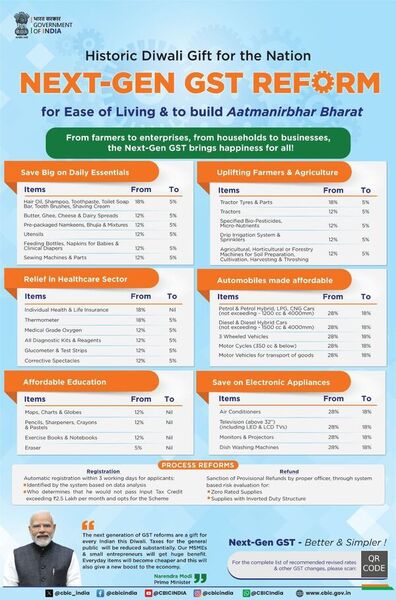
4. The GST Council has introduced a major revision of tax rates.
- This move is aimed at supporting common citizens, key industries, farmers, and the overall economy.
- Taxes on many middle-class and household items have been reduced.
- The previous rates of 12% or 18% are now brought down to 5%.
- All personal life and health insurance policies are now exempt from GST. This includes senior citizen and family floater plans.
- Thirty-three essential life-saving drugs will now attract zero GST. These were earlier taxed at 12%.
- Three critical medicines for cancer, rare diseases, and chronic conditions are also now tax-free. They were earlier under the 5% slab.
- General medicines will now be taxed at 5% instead of the earlier 12%.
- Medical equipment used in healthcare and diagnostics will now attract only 5% GST. Earlier, these were taxed at 18%.
- Daily-use items like shampoo, soap, toothpaste, toothbrushes, bicycles, and kitchen utensils will now fall under the 5% GST rate.
- GST on ultra-high temperature (UHT) milk, paneer, chena, and Indian breads has been removed. These items now have zero GST.
- Food products such as snacks, noodles, chocolates, sauces, cornflakes, butter, ghee, and preserved meat will now be taxed at 5%. Earlier, they were taxed at 12% or 18%.
- Appliances like air conditioners, large TVs, and dishwashers will now attract 18% GST. This is a reduction from the previous 28%.
- GST on small cars and motorcycles has also been reduced from 28% to 18%.
- All types of agricultural equipment will now be taxed at 5% instead of 12%.
- The GST Council has simplified the tax system. It has reduced the number of tax slabs from four to two.
- The 12% and 28% slabs have been removed. Only the 5% and 18% slabs will remain.
- The expected financial impact of these changes is ₹48,000 crore per year.
- However, the government considers this cost sustainable.
- The 56th meeting of the GST Council took place in New Delhi.
- It was chaired by Finance Minister Nirmala Sitharaman.
- The meeting included Chief Ministers, Deputy Chief Ministers, and Finance Ministers from various states and union territories.
- All new GST rates will take effect on September 22nd. This date marks the beginning of Navratri.
(Source: News on AIR)
Topic: Appointments
5. Rajit Punhani took charge as CEO of FSSAI.
- Rajit Punhani assumed charge as the Chief Executive Officer of the Food Safety and Standards Authority of India (FSSAI).
- He is a 1991-batch IAS officer belonging to the Bihar cadre.
- Punhani brings with him over three decades of administrative experience across various levels.
- He earlier served as Secretary in the Ministry of Skill Development and Entrepreneurship.
- He has also worked as Secretary of the Rajya Sabha and Chief Executive Officer of Sansad TV.
- Food Safety and Standards Authority of India (FSSAI) is a statutory body under the Ministry of Health and Family Welfare, Government of India.
- Its headquarters is in New Delhi. It was constituted on September 5, 2008, under the provisions of the Food Safety and Standards Act, 2006.
- This authority regulates the manufacture, storage, distribution, sale, and import of food items while setting standards to ensure food safety.
Topic: Summits/Conferences/Meetings
6. The 20th Global Sustainability Summit addressed by Union Minister Shri Bhupender Yadav in New Delhi on 2 September.
- The event was organized by the CII-ITC Centre of Excellence for Sustainable Development.
- Representatives from more than 10 countries and senior leaders from the industry were present at the gathering.
- Shri Yadav described India’s growth model as one that balances economic progress with ecological responsibility.
- He emphasized that sustainability should be treated not as a target but as a lifestyle rooted in resilience, regeneration, and responsibility.
- He informed that on August 29, 2025, the Government of India had notified the Environmental Audit Rules, 2025, which provide a formal framework for environmental audits across the country.
- The Minister informed that the revised methodology for the Green Credit Programme has been notified on 29th August 2025 to allow greater private participation and eco-restoration.
- On August 31, 2025, the ministry also amended the Forest (Conservation and Augmentation) Rules, 2023, to facilitate the objectives of achieving self-sufficiency in the critical minerals sector under the newly launched National Critical Minerals Mission, 2025.
- Under this mission, 24 minerals have been identified as critical and strategic, and 29 others have been identified as vital for strengthening the country's economy and national security.
Topic: Banking/Financial/Govt Schemes
7. BHARATI initiative has been launched by Agricultural and Processed Food Products Export Development Authority to boost agri-food exports.
Topic: MoUs/Agreements
8. An MoU signed by Indian Railways and SBI to enhance Insurance Benefits for Railway Employees.
-
On 1 September, Indian Railways (IR), one of the largest rail networks in the world, and the State Bank of India (SBI), the country’s largest public sector bank, signed a landmark MoU.
- The signing ceremony was attended by Shri Ashwini Vaishnaw, Hon’ble Minister for Railways, Information & Broadcasting, and Electronics & Information Technology.
- Under the MoU, insurance coverage for Railway employees maintaining salary accounts with SBI has been significantly enhanced.
- In case of accidental death, the insurance benefit has been increased to Rs 1 crore, while the current coverage for Group A, B, and C employees covered under CGEGIS is Rs 1.20 lakh, Rs 60,000, and Rs 30,000, respectively.
- Natural death insurance coverage of ₹10 lakh will also be provided to all employees holding only a salary account with SBI without any premium or medical examination requirement.
- Nearly 7 lakh Railway employees maintaining salary accounts with SBI are expected to benefit from this agreement.
- Key complimentary insurance covers under the MoU include an Air Accident (death) insurance of ₹1.60 crore, with an additional coverage of up to ₹1 crore on the RuPay Debit Card.
- Personal Accident insurance for Permanent Total Disablement has been set at ₹1 crore, while Permanent Partial Disability is covered up to ₹80 lakh.
- The MoU has been described as employee-centric and compassionate, particularly benefiting frontline Group C Railway personnel and other employees.
 Previous

 Latest







Comments